Sailing Croatia in August 2026: How to Win the 4 PM Berth Race
Croatia sailing august crowds and berths sorted: arrive-by times, VHF calls, raft-up etiquette and a plan-B harbour list per region. Win the 4 PM berth race.
Read more
Updated May 2026.
Pula is Croatia’s most northern serious charter base — the country’s Istria peninsula sticks out into the northern Adriatic, surrounded by sheltered cruising waters, a Roman amphitheatre, Venetian harbour towns and the green Kvarner archipelago. A Pula charter feels different from Split or Dubrovnik: shorter distances, more harbour nights, more cultural-history stops, fewer “drop anchor in an empty bay” moments. This guide covers the standard 7-day Istria + Kvarner loop, the boats that suit the region, and the visa/park/permit details first-timers miss.
The Pula cruising ground gives you four things the southern Croatian routes can’t: Brijuni National Park (Tito’s former personal islands, a permit-required visit), Venetian Istria (Rovinj, Poreč, with traceable Italian heritage), the Kvarner archipelago (Lošinj, Cres, Krk, Rab — the wooded, sheltered northern islands), and Susak’s sandy beaches (the only true sand island in Croatia’s stone-and-pine coastline).
The trade-off versus Dalmatia: less open turquoise water, more commercial-marina nights, and a meaningfully different cultural feel — Istria’s roots are Venetian-Italian, Kvarner is Habsburg-influenced. The food scene reflects this: truffle pasta, fuži, prosciutto, Malvasia and Teran wines rather than Dalmatia’s grilled fish + Plavac.
Saturday turnaround at ACI Marina Pula or Marina Veruda (5 minutes from Pula city centre). Provisioning at Konzum or Spar.
Day 1: Pula → Brijuni — 8 nm. Quick hop to the Brijuni National Park. Pre-book your entry permit at least 48 hours ahead; private yacht visits are restricted. Anchor in the approved zone, take the small boat ashore for the park (Tito museum, dinosaur footprints, deer park, Roman ruins). Night back at Veruda or anchored at Fažana.
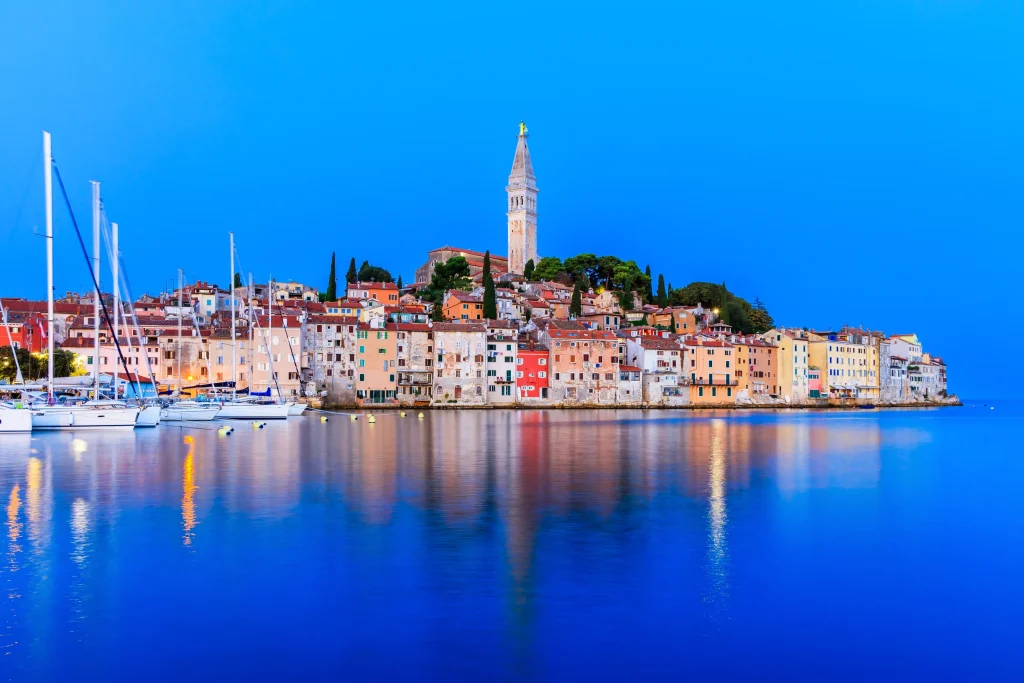
Day 2: Brijuni / Veruda → Rovinj — 20 nm. North up the Istrian coast to Rovinj. ACI Marina Rovinj or anchor in Lone Bay. Walk the old town, dinner at Monte or La Puntulina, sunset at the church-on-the-hill viewpoint. The trip’s marquee night.
Day 3: Rovinj → Cres (Cres town or Beli) — 30 nm. Longer leg east across the open water to the Kvarner archipelago. Cres town has a small harbour and good restaurants; Beli (north Cres) is the off-the-beaten-track alternative with the griffon vulture sanctuary above.
Day 4: Cres → Mali Lošinj — 22 nm. Down the Lošinj channel to the archipelago’s yachting hub. Full marina amenities, dolphin-spotting offshore (the Lošinj dolphin colony is the Adriatic’s most-studied). Evening konoba dinner — Diana, Bora Bar or any of the working harbours.
Day 5: Mali Lošinj → Susak — 8 nm. Short hop to Susak — Croatia’s only sandy-beach island. Anchor in the bay, swim, lunch at one of the village taverns. Sail back to Mali Lošinj or push to Ilovik for the night.
Day 6: Lošinj / Susak → Rab — 28 nm. Cross to Rab island — the medieval bell-tower skyline, a working old town, and Lopar’s sand beaches if you missed Susak’s. Rab town’s ACI is small; the larger marina is Supetarska Draga.
Day 7: Rab → Pula — 38 nm. The longest sail of the week back to Pula. Or break the leg with a night at Punat (Krk) and stretch to a 9-day charter. Fuel at Veruda, return.
Istria’s shorter distances and developed marinas mean smaller cats work well — you spend more nights at marinas than at anchor, so the boat’s anchoring kit matters less than its docking dimensions.
Sweet spot — 40-42 ft: Lagoon 40, Bali 4.0, Fountaine Pajot Astrea 42. All fit comfortably in the smaller Istrian harbours (Rovinj, Cres, Susak). Peak rate €5,000-9,000.
Family option — 45-46 ft: Lagoon 46, Bali 4.6. Works for 8 crew, fits all marinas including the smaller Kvarner harbours. Peak rate €8,500-13,500.
Avoid 50-ft+ on a Pula charter unless you accept more nights at the larger commercial marinas (Veruda, ACI Pula, Mali Lošinj) and skip the smaller harbour stops.
Istria is the Croatian region where the catamaran-vs-monohull choice is closest. Three reasons: (1) Shorter distances mean less time motoring at the cat’s cruising-rpm fuel burn. (2) More marina nights than anchor nights shifts the cost equation against cats — you’ll pay 1.5-1.8x monohull rates at Rovinj ACI, Mali Lošinj ACI and Veruda. (3) The northern Adriatic is sheltered, so the cat’s stability-at-anchor advantage matters less than in the open Dalmatian crossings.
That said, the cat still wins on living space (the wider beam matters more for 6-8 crew on a 7-day trip than for 2-4 on a 3-day weekend), and on shallow-draft access to Susak’s sandy approaches, Cape Kamenjak’s anchorages south of Pula, and the inner Brijuni channels. For 4 crew, a monohull is workable; for 6-8 crew, the cat is worth the marina premium.
Brijuni National Park. Yacht entry is regulated — you must pre-book through the park office at least 48 hours ahead (some sources recommend 7 days for July-August). Day visits only for most charter yachts; overnight permits are scarce and pricey. The park entry fee is roughly €30-65 per person for a guided land visit on top of the boat permit.
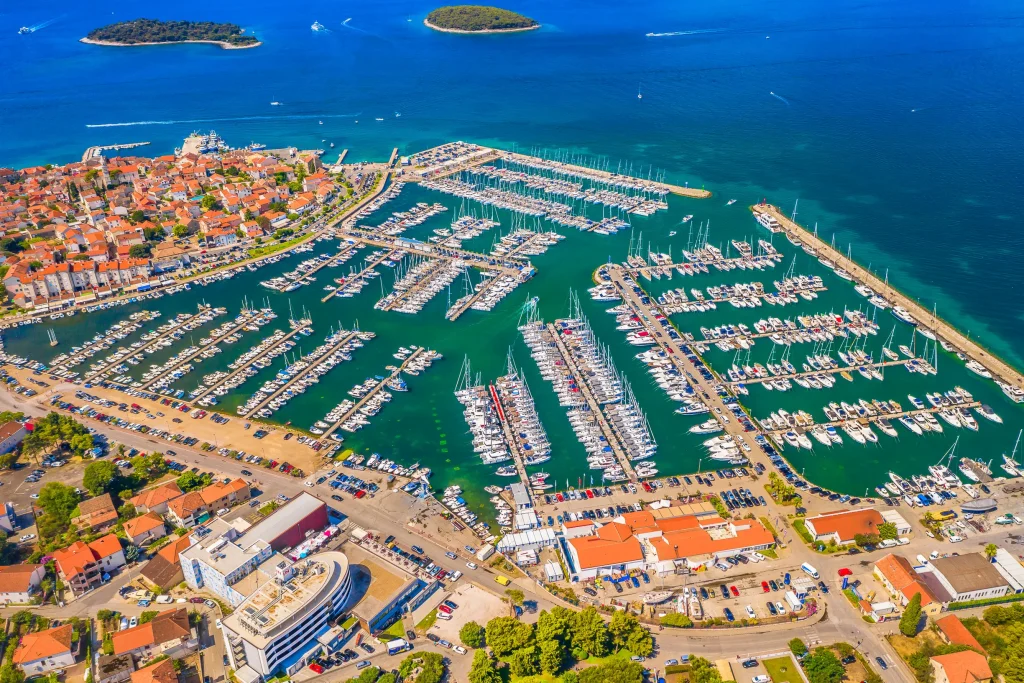
Marina fees 2026. ACI Pula and Veruda €90-160 for a 45-ft cat; Rovinj ACI €110-200 (premium pricing); Mali Lošinj ACI €100-180; Rab ACI smaller, €75-140; Punat ACI (Krk) €90-150.
Pickup logistics. Pula airport (PUY) is 10 minutes from Veruda Marina — the easiest charter airport-to-marina transfer in the country. Direct flights from London, Manchester, Frankfurt, Munich, Vienna, Stockholm, Warsaw April-October. Trieste (Italy) and Ljubljana (Slovenia) are 2-hour drives if Pula has no good slots.
Provisioning. Konzum and Spar in Pula city; supermarket runs at Rovinj (Plodine), Mali Lošinj (Tisak Plus, Konzum), Rab town. Susak has no supermarket (one small shop, basic only).
Cuisine note. Istria is Croatia’s truffle, prosciutto and olive-oil capital. Plan one konoba dinner specifically for the truffle pasta and book the inland village option (Motovun, Grožnjan, Završje) if you can rent a car for a day from Rovinj or Pula. Worth it.
For a 42-46ft cat with 6-8 crew in late June 2026:
— Boat charter: €5,500-11,000 bareboat (Istria rates run slightly below Dalmatia equivalents).
— Provisioning: €30-55 per person per day.
— Brijuni permit + park: €200-400 depending on crew size.
— Marina nights: €700-1,200 for the week (more marina-heavy than southern Croatia routes).
— Fuel: €180-350.
— Tourist tax: €1.50/person/night.
All-in trip cost for an 8-person bareboat week: roughly €11,000-16,500.
Six things to lock in before arrival:
— Book your Brijuni day-visit permit through the National Park office at least 48 hours ahead (7+ days for July-August). Without it your yacht cannot enter the park waters.
— Reserve Rovinj ACI Marina for the marquee night — the marina is small and the most popular Istrian harbour; lock it in 6+ weeks before peak departure.
— Plan one inland Istria day — rent a car from Rovinj or Pula for a truffle-and-Malvasia lunch at Motovun, Grožnjan or Završje. The food is the trip’s highlight; missing it is missing the point of an Istria charter.
— Pre-book Mali Lošinj’s marina + a dolphin-watching tour if your crew is interested in the Lošinj dolphin colony — the certified tours through Blue World Institute are limited daily.
— Pack for Bura — the strong NE katabatic wind hits the Kvarner gulf in shoulder months (May-June and September) more reliably than in Dalmatia. Bura jacket + lighter pants for the open-water Cres-Rab leg.
— Provisioning at Pula’s Konzum or Spar is straightforward, but stock heavier than usual — Susak has only one tiny shop, and the Kvarner village stops (Beli, Susak village) carry only basics.
— Sailing from Split: Central Dalmatia routes & best catamarans.
— Sailing from Šibenik: Kornati National Park & Krka routes.
— Sailing from Dubrovnik: South Dalmatia & Elaphiti routes.
Browse the 2026 fleet on the www.croatia-yachting.com fleet page. For a custom Istria + Kvarner itinerary, contact us via the site and we’ll come back within 24 hours.
Yes — meaningfully. Pula’s cruising ground (Istria + Kvarner) has shorter distances between stops, more marina nights than anchor nights, a strong Venetian and Habsburg cultural overlay rather than Dalmatian, and a different food scene (truffle, prosciutto, Malvasia wines). It’s the right pick for crews who want a softer pace, cultural-history stops and a more European-Italian feel rather than the wide-open Dalmatian island anchorages.
Yes — private yacht visits to Brijuni are tightly regulated. You must pre-book through the park office at least 48 hours in advance (7+ days recommended for July-August peak). Day visits with a guided tour ashore are standard; overnight stays in the park are restricted to a small number of permits at premium pricing.
40-46 ft is the sweet spot. The smaller Istrian and Kvarner harbours (Rovinj, Cres town, Beli, Susak, Rab) handle 40-46-footers without trouble; bigger boats get pushed to commercial marinas at Veruda, Mali Lošinj and Punat. Couples and 4-person crews do well on a Bali 4.0 or Lagoon 40; 6-8 crew on a Lagoon 46 or Bali 4.6.
Worth including for a 7-day charter — Istria alone is a 4-5 day route. The Kvarner crossover (Cres, Lošinj, Susak, Rab) gives you the contrast: Venetian harbour towns west, Habsburg-influenced wooded islands east. Skipping Kvarner cuts the route’s variety in half.
Northern Adriatic weather is reliably warm and sunny from late May through September. The bura (a strong NE katabatic wind) can blow in shoulder months — check forecasts. The afternoon maestral (NW) is gentler than in Dalmatia. Water temperatures lag — swimming gets comfortable in early June and stays warm into early October.
Six short questions, then a real reply from a www.croatia-yachting.com broker within four working hours.