Korčula by Boat: Moorings, Lumbarda Beaches & Pošip Cellars
Korcula by boat, done right: ACI marina vs town quay vs Lumbarda anchorage, the Badija swim stop, and tasting Pošip at the source. Plan your island stop.
Leer más
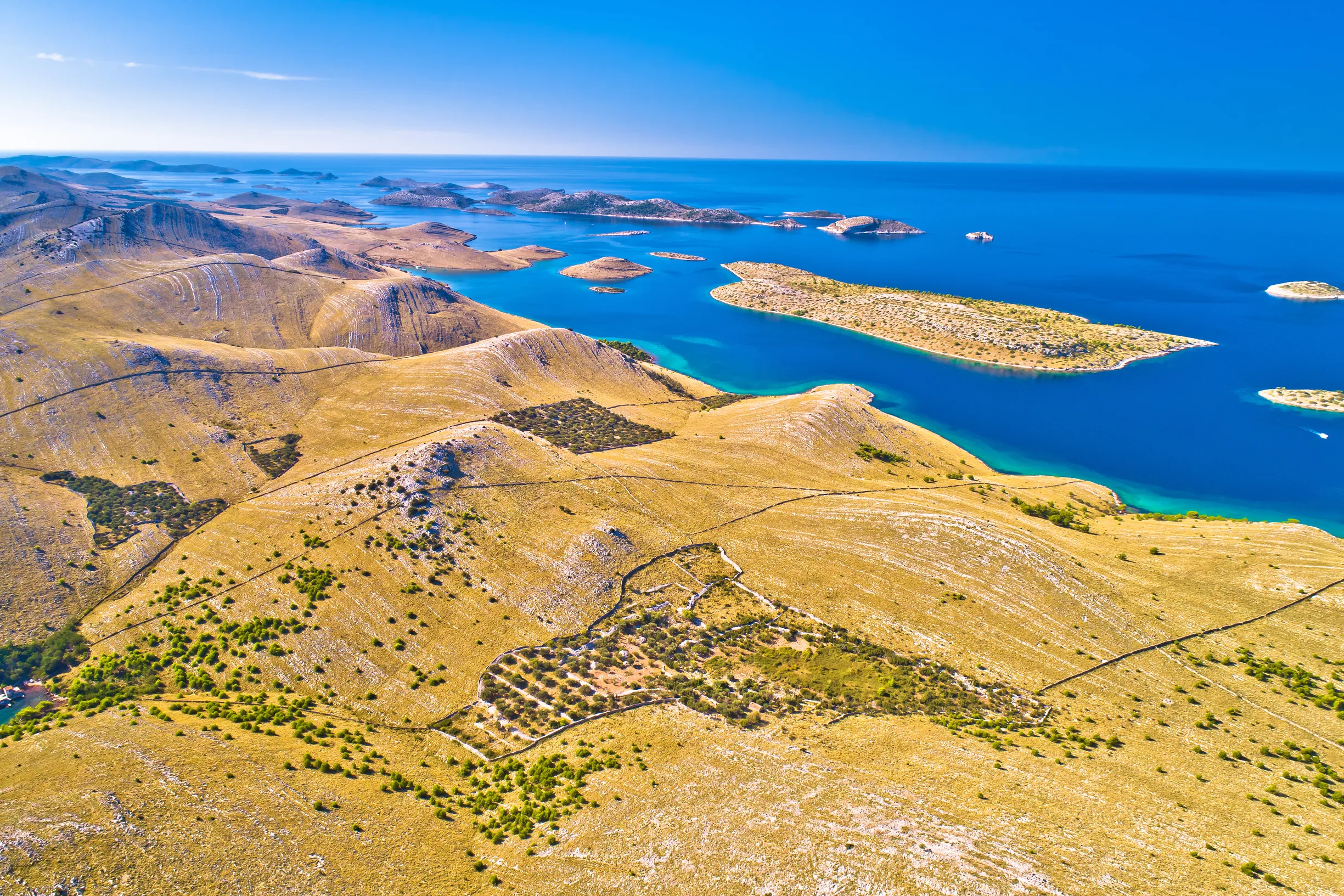
Trogir is the base most experienced charterers in central Dalmatia quietly prefer, and the reason is almost embarrassingly simple: the airport is a ten-minute taxi from the pontoon. While crews flying into Split fight the changeover-day traffic across the city, a yacht charter trogir crew can land, clear arrivals and be loading provisions onto the boat before lunch.
This guide finishes our central-Dalmatia base series. It covers how Trogir’s two main marinas differ, what the town itself gives you on the first and last night, and where to point the bow once you cast off — including the Šolta and Drvenik stops that make a tight changeover day feel relaxed. It sits alongside our Split base guide and central-Dalmatia routes, since the two share the same cruising ground.
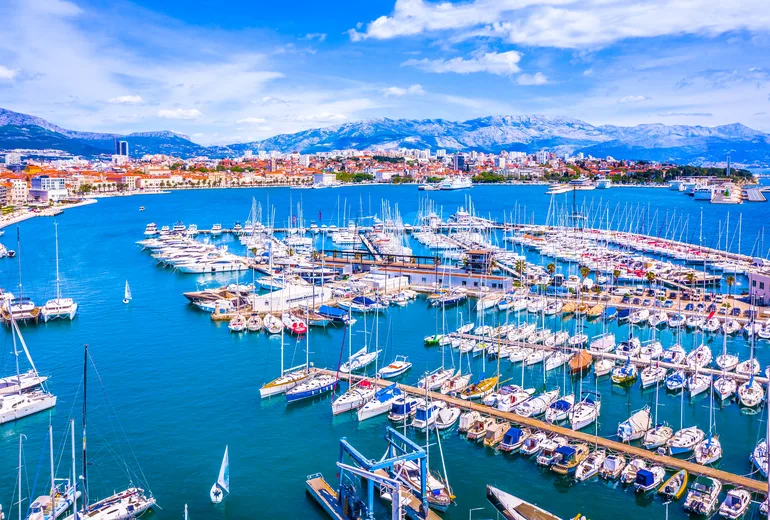
The case for Trogir is logistics. Split airport sits at Kaštela, which is actually closer to Trogir than to Split city — so flying into “Split” and basing in Trogir gives you the shorter transfer, not the longer one. On a Saturday in August, when the city marinas are gridlocked and the Riva is shoulder-to-shoulder, that difference is the gap between a calm start and a frazzled one.
Trogir’s old town is also a genuine destination in its own right, not just a marina dormitory. The whole island core is UNESCO-listed: the cathedral of St Lawrence with its carved Radovan portal, the Kamerlengo fortress on the point, narrow stone lanes that stay lively into the evening. You can spend the first night here without feeling you’ve wasted a day, then sail out fresh on Sunday morning.
There’s a large supermarket a short walk or quick taxi from both main marinas, plus the daily market by the town bridge for fruit, vegetables, cheese and oil. Sort the heavy shop before you settle in, because once you’re on the boat the temptation is to never leave. If you’re arriving late, several marinas allow boarding from the afternoon — confirm your check-in window when you book.
The central-Dalmatian channels around Trogir are sailed by the same two summer winds you’ll meet everywhere on the coast. The maestral is the friendly one — a thermal northwesterly that builds from late morning to 12–18 knots and dies at dusk, perfect for an afternoon reach out to Šolta or Brač. The bura, a gusty cold northeasterly, is the one to watch; it can come up fast and hard, especially around the Vis channel and the open water south of Šolta. The jugo, a humid southerly, builds slower but brings swell and rain. June and September give you the steadiest conditions and the quietest marinas; July and August are reliably warm but busy, which is exactly when Trogir’s quick changeover earns its keep. For a fuller breakdown of when to go, our guide to the best time to sail Croatia by season, wind and crowds is the place to start.
Most Trogir charters start from one of two marinas facing each other across the Trogir channel, and they have distinct personalities.
SCT — formerly Marina Trogir — sits right on the old-town waterfront. The draw is location: step off the boat and you’re in the historic centre, with restaurants and bars a two-minute walk away. It’s the better choice if you want the first or last night spent ashore in Trogir itself. The trade-off is that the town-side quay can be busy and a touch more exposed to wash from passing traffic.
Baotic sits across the channel on the Čiovo side, a larger, more modern marina with deeper berths and a calmer feel. It’s a short walk over the Čiovo bridge into town, or a couple of minutes by dinghy. Many of the bigger catamarans and newer boats are based here. If your crew values a quiet, well-serviced base and doesn’t mind a five-minute walk to the old town, Baotic is the smoother option. Either way, marina fees for the home berth are usually folded into your charter, so the practical question is just which side of the channel suits your crew.
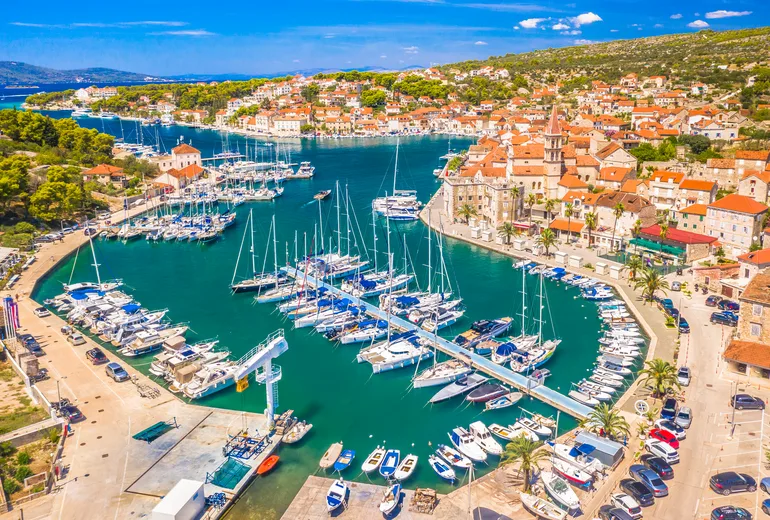
Two schools of thought. Stay in Trogir for the first night, enjoy the old town, and start the cruise rested on Sunday — sensible if your flight lands late. Or, if you’re aboard by early afternoon, slip the lines and make a short first hop so you wake up already out among the islands.
If you sail, the closest worthwhile anchorages are barely an hour or two away, which is the whole point of a base this efficient. You lose none of the first day to repositioning, and you skip the Saturday-evening marina crowds.
From Trogir the islands open up fast. Two stops in particular make ideal first or last nights.
Šolta is the nearest proper island, about 10–12 NM south — an hour and a half to two hours in a typical maestral. Head for Maslinica on its western tip, a stone village with a small marina (Martinis Marchi), a restored 18th-century castle now run as a boutique hotel, and the seven Šolta islets scattered just offshore that make for excellent snorkelling. The adjacent Šešula bay is a deep, well-protected inlet with restaurant moorings — a classic first-night anchorage where you tie to a buoy, eat ashore at a konoba and dinghy back under the stars. Šolta is also worth a stop for what it’s known for on land: pungent local olive oil, the Dobričić red grape that’s a parent of Plavac Mali, and jars of island honey sold from doorways. It stays markedly quieter than Brač or Hvar, which makes it the better soft landing for a first or last night.
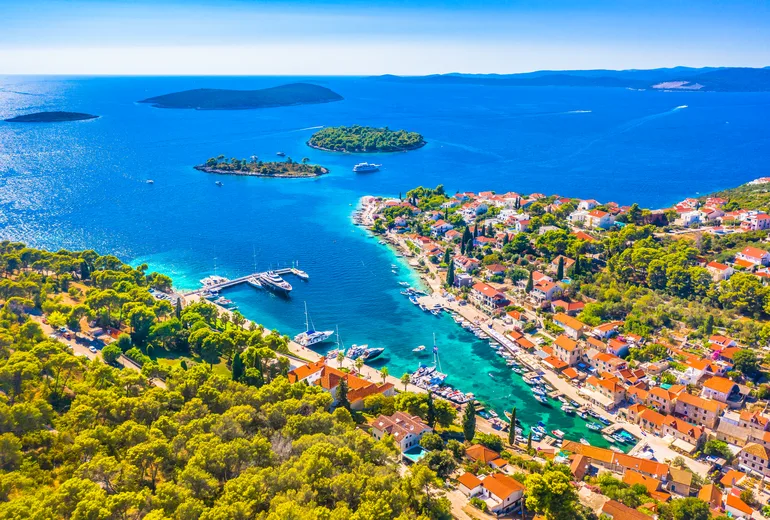
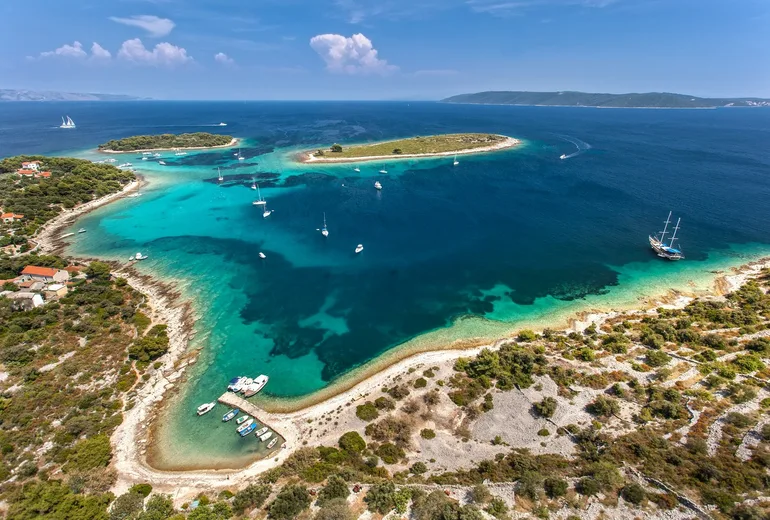
Just southwest of Trogir lie Drvenik Veli and Drvenik Mali, and between them the Krknjaši bay — the so-called Blue Lagoon, a shallow turquoise basin behind a low islet. It’s only about 6 NM from base, so it works equally as a first swim stop or, crucially, as a final-night anchorage close enough to guarantee an on-time return on changeover morning. Pick up a mooring buoy (there’s a seasonal restaurant ashore) and you’ve got a calm, scenic last night with a fifteen-minute motor home. Be aware that it’s no secret — day-trip boats from Trogir and Split pour in around midday, so the bay is liveliest from late morning to mid-afternoon and empties out by evening. Time your arrival for after 5 pm and you’ll often have it largely to yourself overnight.
If the Blue Lagoon is too busy when you arrive, Drvenik Veli has calmer alternatives. Mala and Vela Rina on the island’s south side are deep, sheltered inlets that take the bura well and rarely fill, and the small harbour at Drvenik Veli village has a handful of berths and a konoba or two. It’s the kind of island where the day-trippers cluster in one bay and the rest stays empty — handy local knowledge for a final night.
For a full seven days, Trogir feeds neatly into the central-Dalmatia classic: out to Šolta or the Drveniks, on to Vis and Komiža for the wildest island in the group, across to Hvar and the Pakleni for a night of buzz, then back through Brač — Milna or Bobovišća — before a final easy stop at the Blue Lagoon for the run home. That’s roughly 120–150 NM over the week, comfortably paced, with the airport never more than a half-day’s sail away. The island-hopping legs from Split apply directly from Trogir, and to keep mooring costs predictable as you go, the Croatian marina guide comparing ACI and private marina fees is worth a read before you set the route. For where to provision at each base along the way, our Croatia provisioning guide maps out the best shops near every marina.
Tighter on time, or sailing in busy August? Build in a berth-booking strategy so you’re not gambling on quay space in Hvar at peak — our piece on planning an August week in Croatia with a berth race and a plan B is worth reading before you finalise the itinerary.
Don’t rush the final night. Plan the route so you’re back at base by late afternoon on Friday, then give the old town the evening it deserves. The compact island core is car-free and best explored on foot: start at the cathedral of St Lawrence and its Romanesque Radovan portal, climb the bell tower for the rooftop view, then walk the seafront promenade out to the Kamerlengo fortress on the point. For dinner, the lanes behind the Riva hide good konobas doing grilled fish, lamb under the peka bell (order ahead — it takes a couple of hours), and Dalmatian pašticada. A glass of local Babić or Pošip on the waterfront as the day-boats thin out is a fitting close to the week, and you’re a two-minute walk from the boat when you’re done. Settling the home berth and provisioning the night before also means a calm, early changeover with the airport just down the road.
Very close — about a ten-minute drive. The airport is at Kaštela, between Split and Trogir, and is actually nearer to Trogir than to Split city centre. That short transfer is the main reason many crews choose Trogir as their base.
Pick SCT if you want to step straight into Trogir’s old town from your berth and don’t mind a busier quay. Choose Baotic on the Čiovo side for a larger, calmer, more modern marina with deeper berths and an easy walk over the bridge into town. Bigger and newer boats are more often based at Baotic.
Šešula bay on Šolta and the Krknjaši Blue Lagoon off Drvenik Veli are both excellent — sheltered, scenic and an hour or two from base. The Blue Lagoon doubles as an ideal final-night anchorage because it’s close enough to guarantee an on-time return on changeover day.
It’s one of the better ones. The short airport transfer, easy provisioning, sheltered nearby anchorages and a forgiving run out to the central islands all suit crews who want a low-stress start. If it’s your first bareboat week, the gentle first-night options here make the changeover far less daunting.
Comparing bases for your Adriatic week? See how Trogir lines up with the rest of the coast on our Croatia sailing destinations page and find the boat to match your route.
Seis preguntas breves y, después, una respuesta real de un bróker de www.croatia-yachting.com en cuatro horas laborables.