Sailing from Trogir: Marinas, 10-Minute Airport Transfers & Your First-Night Plan
A yacht charter trogir guide: how SCT and Baotic marinas compare, why the airport sits 10 minutes from the pontoon, and the best first-night stops nearby.
Mehr lesen
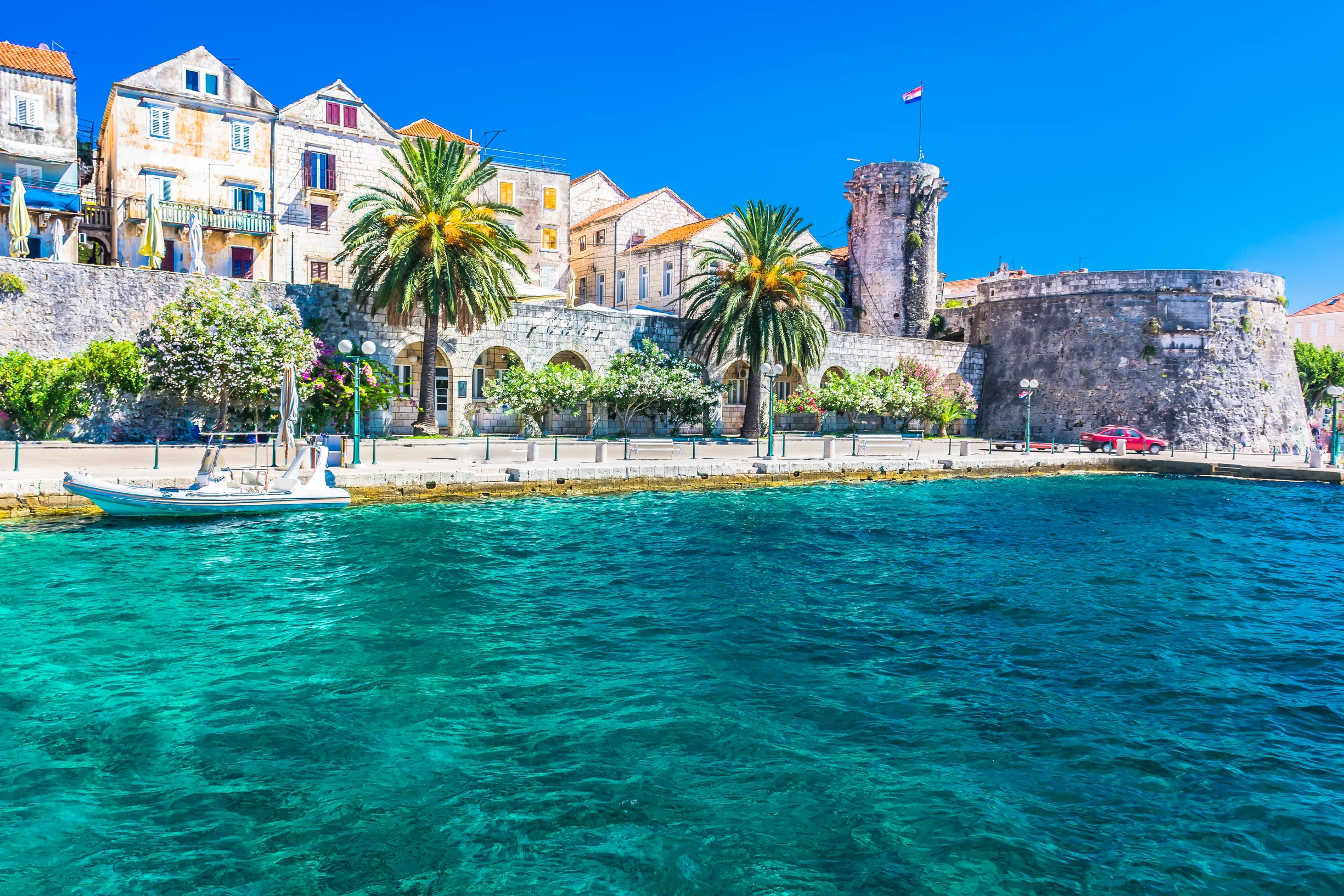
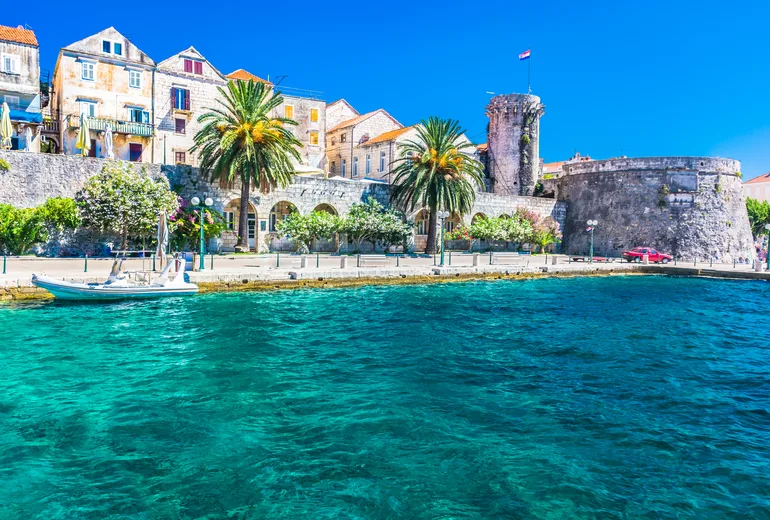
Korčula rewards crews who arrive by sea more than almost any island on the Dalmatian coast, which is why exploring Korčula by boat beats the day-trip ferry every time. The walled old town juts out on a tiny peninsula, its towers and red roofs designed to be seen from the water — and from your own deck you get the front-row view that the packed catamaran shuttles never quite match.
Visiting Korčula by boat means three decisions up front: where to leave the boat for the night, how to fit in the swim stops and beaches, and how to taste the island’s famous Pošip white without renting a car. This brief covers all three, plus the run down the southern chain it anchors. It pairs naturally with our South Dalmatia and Elaphiti routes from Dubrovnik, since Korčula is the obvious mid-point on that itinerary.
There’s no single right answer here — it depends on what you want from the night. Three options sit within a short hop of the old town.
The ACI marina is tucked just east of the old town, a few minutes’ walk along the waterfront. It’s the secure, no-stress choice: laid moorings, water, power, showers and a fuel berth nearby. In peak August it fills early, so book ahead or arrive by mid-afternoon. Expect ACI’s premium rates — a mid-size yacht runs in the region of €90–150 a night depending on length and season — but you get the convenience of stepping straight into town for dinner.
You can also moor stern-to on the town quay right below the old walls, which is about as central as it gets. It’s atmospheric and usually a touch cheaper than the marina, but it’s more exposed — the channel between Korčula and the Pelješac peninsula funnels current and the afternoon maestral, and a strong jugo from the south makes it uncomfortable. Good in settled weather, less so when it blows.
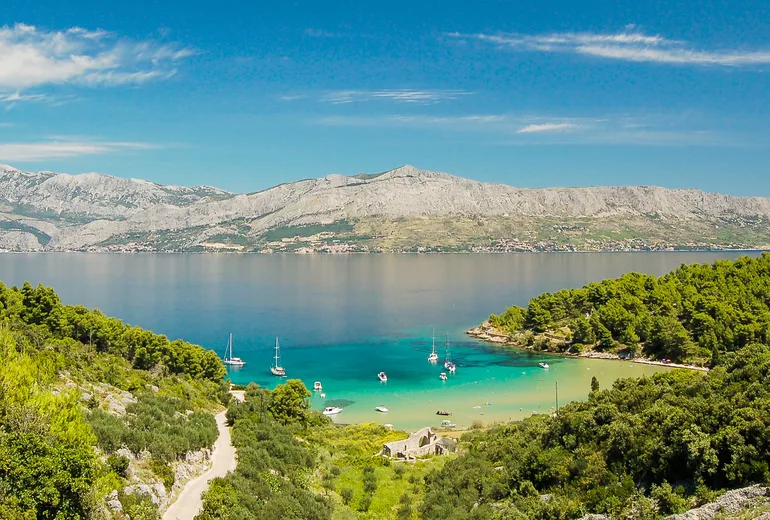
For a quieter night, sail 6 km southeast to Lumbarda, where a cluster of bays gives sheltered anchoring over sand — genuinely good holding, which isn’t a given in Croatia. You trade the walk-to-dinner convenience for calm water, a sand beach and the island’s vineyards on your doorstep. Many crews split the difference: anchor or moor at Lumbarda, then taxi or dinghy-and-walk into Korčula town for the evening. There’s also a small marina at Lumbarda if you’d rather not lie at anchor, plus a couple of pontoons run by waterfront restaurants where a dinner reservation comes with a free berth — worth a phone call ahead in August.
Once you’re moored, the old town earns a proper evening on foot. The street plan is a clever piece of medieval engineering — a central spine with ribs of side streets angled to let the cooling maestral in while blocking the cold bura, so it stays comfortable on a hot August night. Climb the bell tower of St Mark’s Cathedral for the rooftop view over the channel, and duck into the house that local lore ties to Marco Polo, whom Korčula claims as a native son (the evidence is thin, but the viewpoint from the tower is real enough). In the second half of summer you may catch a performance of the Moreška, the island’s centuries-old sword dance staged in the open air — a genuine local tradition rather than a tourist turn. Dinner in the old town runs to grilled fish, žrnovski makaruni (hand-rolled pasta from the nearby village of Žrnovo) and, of course, the island’s whites by the glass.
The water around Korčula is some of the clearest on this stretch of coast, and two spots stand out.
Badija is a forested islet just off the old town, home to a 14th-century Franciscan monastery and a resident population of friendly deer. Anchor off its pebble coves or pick up a buoy, swim in the clear channel, and dinghy ashore to walk the monastery grounds. It’s the easiest swim stop on the island — five minutes from the marina, and a world quieter.
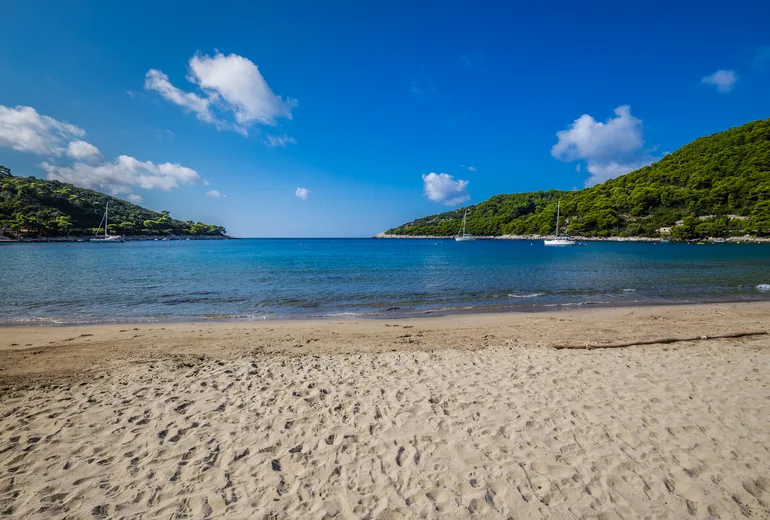
Lumbarda has something rare in Croatia: actual sand. Pržina and Bilin Žal are shallow sandy beaches that shelve gently, ideal for families and for a long anchored afternoon. The sand here isn’t just for swimming — it’s the secret behind the island’s most famous wine, which we’ll get to next. Between the two beaches you can spend a full lazy day at anchor without moving far.
Korčula is one of Croatia’s serious wine islands, and the great thing about arriving by boat is that the best cellars are walkable or a short taxi from where you’ll moor.
Pošip is the island’s flagship white — full-bodied, citrus-and-stone-fruit, grown mainly in the inland valleys around Čara and Smokvica. Several family wineries there welcome visitors for tastings; it’s a 20-minute taxi from Korčula town and well worth the trip for a proper sit-down flight rather than a glass at a bar.
The island’s other gem is Grk, a rare white grown almost exclusively in the sandy soils of Lumbarda — which is exactly why anchoring there pays off twice. Walk from the beach into the village and several small producers pour Grk straight from the cellar. Tastings typically run €10–20 a head, often with a plate of local cheese and pršut. Buy a few bottles for the boat while you’re there; neither wine travels widely, so this is the place to drink them.
Korčula rarely stands alone — it’s the linchpin of any southern-Dalmatia cruise. Coming from the north, it’s a natural stop after Hvar and Vis; coming from the south, it’s the obvious overnight on the way to or from Dubrovnik. Across the channel, the Pelješac peninsula adds its own reds and the famous oyster beds of Mali Ston, both easy detours.
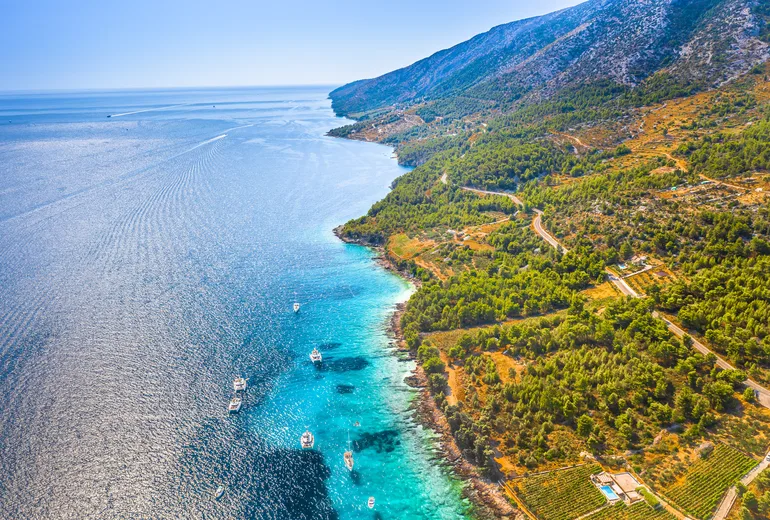
The channel between Korčula and Pelješac is narrow enough that the peninsula feels like part of the same trip. Sail across to Orebić, a short hop from Korčula town, for a different anchorage and a beach day under Mount Sveti Ilija. Push a little further and you reach the steep coastal vineyards of Dingač and Postup, where the Plavac Mali grows on slopes so sheer the grapes were once lowered by boat — the reds from here are among Croatia’s most serious, and several cellars in Potomje and along the road pour them. At the peninsula’s neck, Mali Ston is the place for oysters straight from the bay, eaten at a waterside table with a squeeze of lemon. None of it is more than a half-day from Korčula, which is what makes this stretch such a rewarding cruising ground.
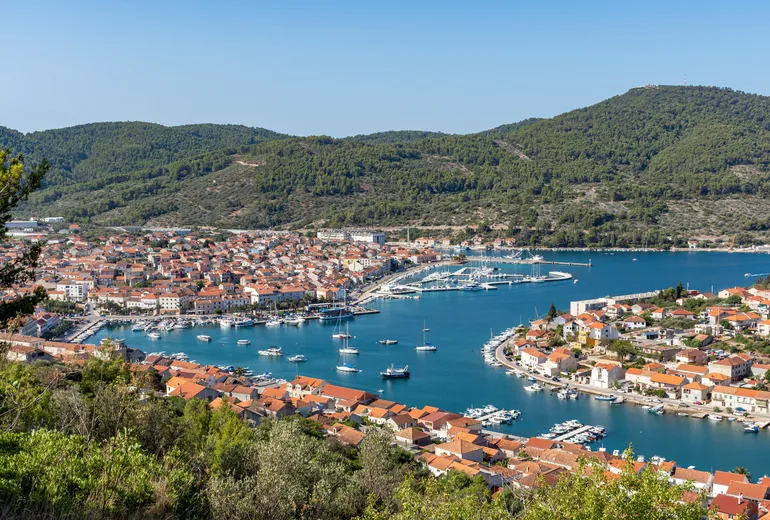
Most crews moor at Korčula town, but the island has a second harbour worth knowing. Vela Luka, at the western tip, sits at the head of a long, deeply sheltered bay — a calm, working-town alternative with good provisioning, a few quiet anchorages nearby, and the Vela Spila cave above town for a morning ashore. It’s the natural stop if you’re approaching Korčula from Hvar or Vis rather than from the Dubrovnik side.
A common loop: Korčula, then Mljet with its national-park lakes, then the Elaphiti islands of Šipan and Lopud, then Dubrovnik — a relaxed three or four days of short hops. The reverse works just as well from a Dubrovnik base. For the full southern itinerary and the Elaphiti detail, the Dubrovnik base guide linked above is the companion read, and for the food-and-mooring strategy along the way, our konoba dining and free moorings guide covers the konobas worth planning around. To keep the marina spend in check on a southern loop, the Croatian marina guide on ACI versus private marina fees is a useful primer.
The Korčula channel is one to respect: current runs through it, and the afternoon maestral can build a short, awkward chop against the tide. Plan your approach to the town quay for the calmer morning if you can. Provisioning is good in Korčula town — a supermarket near the marina and a small market — but thinner at Lumbarda, so stock up before you anchor for the night. The old town is car-free and steep in places, so leave the heavy bags on the boat.
To see which boats are positioned for a southern-chain route and compare prices for these dates, browse our Croatia charter fleet and filter by base and length.
ACI Marina Korčula is the secure, convenient choice right by the old town, though it books up and charges premium rates in summer. The town quay is more central and atmospheric but exposed to current and wind. For a calm night over good sand holding, anchor at Lumbarda and head into town for dinner.
The Pošip cellars are inland around Čara and Smokvica, about a 20-minute taxi from Korčula town — easy to arrange for a tasting. If you’d rather walk, anchor at Lumbarda instead and visit the village’s Grk producers on foot; Grk is the local sandy-soil white you won’t find elsewhere.
Yes. Lumbarda’s sandy, gently shelving beaches at Pržina and Bilin Žal are among the few real sand beaches in Croatia, and the sheltered anchoring there suits a long, easy day with kids. Badija island adds a short swim-and-explore stop close to the marina.
It’s the central stop on the southern chain — a natural overnight between Hvar or Vis to the north and Mljet, the Elaphiti islands and Dubrovnik to the south. Most crews fold it into a three-to-four-day run of short hops in either direction.
Planning a southern-Dalmatia week around Korčula? Explore the wider region on our Croatia sailing destinations page and match a boat to your route.
Sechs kurze Fragen, dann eine echte Antwort eines www.croatia-yachting.com-Brokers innerhalb von vier Arbeitsstunden.