— Route · 14 days · round-trip
Yacht charter route · Split, Croatia

Trogir
via Dubrovnik (14 Days).

From ACI Trogir to Dubrovnik and back in two unhurried weeks: swims at Šolta, the Pakleni, Vis caves, Lastovo and Mljet's lakes, then walks on Korčula and Hvar.

Trogir – Dubrovnik (14 Days)
Map and stops

Where each day goes

Tap a pin on the map, or a day in the leg-by-leg list further down, to open that stop with its notes and photos.

Maslinica
Day 1

Trogir → Maslinica (Šolta)

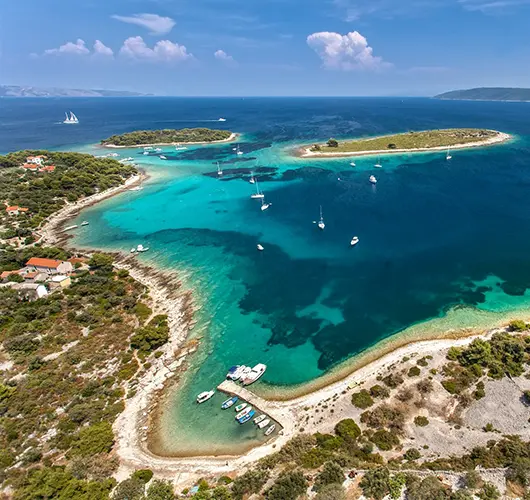
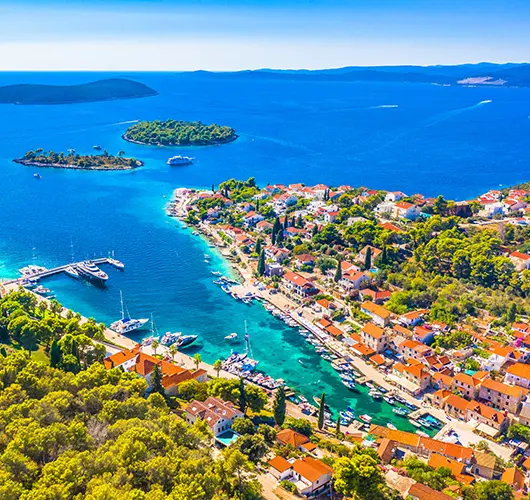
An easy first sail of eight miles from ACI Trogir to Maslinica on Šolta. The harbour sits behind a ring of seven islets, so the water stays calm for a first swim and the island is quiet.

Distance

7 NM

Sailing

~1.4h at 5 kn

This week in brief

When to sail

May to early October, busiest June to September

Duration

14 days · Sat – Sat

Departure

Trogir

Sailing area

Split

Leg by leg

Pick a day to go back to the map with that day's photos, notes and berthing advice.

In detail

The week, day by day

Each leg written out: where the day takes you, where to swim and eat, and where to tie up for the night.

Day 1 / 14
Maslinica
1
Day 1

Trogir → Maslinica (Šolta)

Crews flying into Split have the shortest transfer to this base: ACI Marina Trogir lies on the western side of Čiovo, just across from the UNESCO old town of Trogir, ten minutes by car from the airport. It is the smallest of the three charter bases around Split but sits in the middle of them. The first passage is gentle. Go out through the channel at the Trogir bridge, follow the south coast of Čiovo, and cross eight miles south to Šolta, rounding its western tip into Maslinica. The harbour is deep and curves like an S, with hills behind the village and seven small islets breaking it open towards the sea. Two berthing options face each other. Martinis Marchi Marina, on the south side, has lazy lines and a hotel in a baroque castle; the village quay on the north side takes boats stern-to on their own anchor. Šolta is the island closest to Split and the quietest of the central group, with no day-trip traffic. Its konobas cook with Šoltansko olive oil and pour the local Dobričić red.

Things to do

Step into the courtyard of the old castle

Taste Dobričić, the grape grown only here

Swim off Stipanska island

Buy local olive oil from the village shop

End the day on Polebrnjak islet at sunset

Mooring tip

The marina on the south side has lazy lines and full services; book in July and August. The north-side village quay takes stern-to boats on their own anchor for a small fee. The islets at the entrance keep the bay sheltered from south through northwest; only a northerly, unusual in summer, reaches it.
Milna
2
Day 2

Maslinica → Milna (Brač)

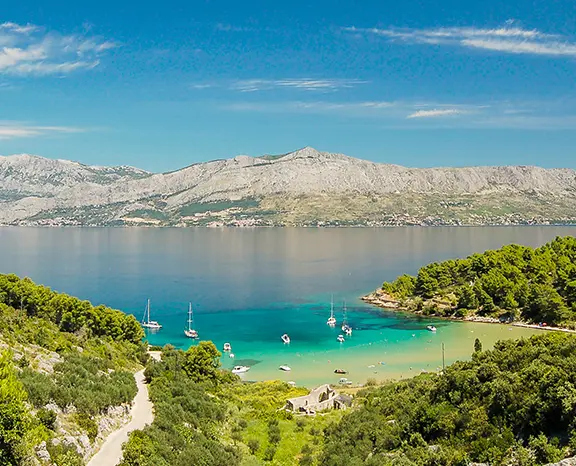
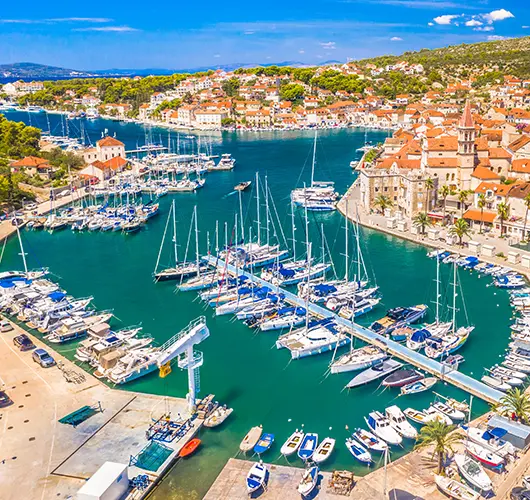
There is no need to hurry this morning. Milna is twelve miles east, and the deep, narrow inlet on Brač's west coast has been a working harbour since Venetian times. Head for the 17th-century parish church on the inner quay. Beyond it the bay narrows, and the whole inner half takes boats stern-to on their own anchor. The outer half is for anchoring in 6 to 10 metres of sand, adding a stern line to the rocks if the Maestral rises in the afternoon. Brač is known for two things. The first is its white limestone, quarried for centuries at Pučišća on the north coast and used for Diocletian's Palace. The second is lamb under the peka, the three-hour Sunday lunch of the village. Place the order by 14:00, because the slow cooking under hot embers cannot be shortened. Then spend the wait swimming and walking out to the small church on the headland north of the bay.

Things to do

Put in your peka order by two o'clock

Visit the church that marks the inner quay

Swim from the boat in the outer anchorage

Find Brač olive oil at the village cooperative

Take the dinghy to Bobovišća for an evening dip

Mooring tip

Lie stern-to on your own anchor at the inner town quay for a small fee, with water and power in the middle. Anchoring in the outer bay is free, with a stern line to the rocks as usual for charter boats. The harbour opens to the southwest and west, yet the inner quay stays calm in an afternoon Maestral above 15 kn.

Palmižana
3
Day 3

Milna → Palmižana (Hvar)

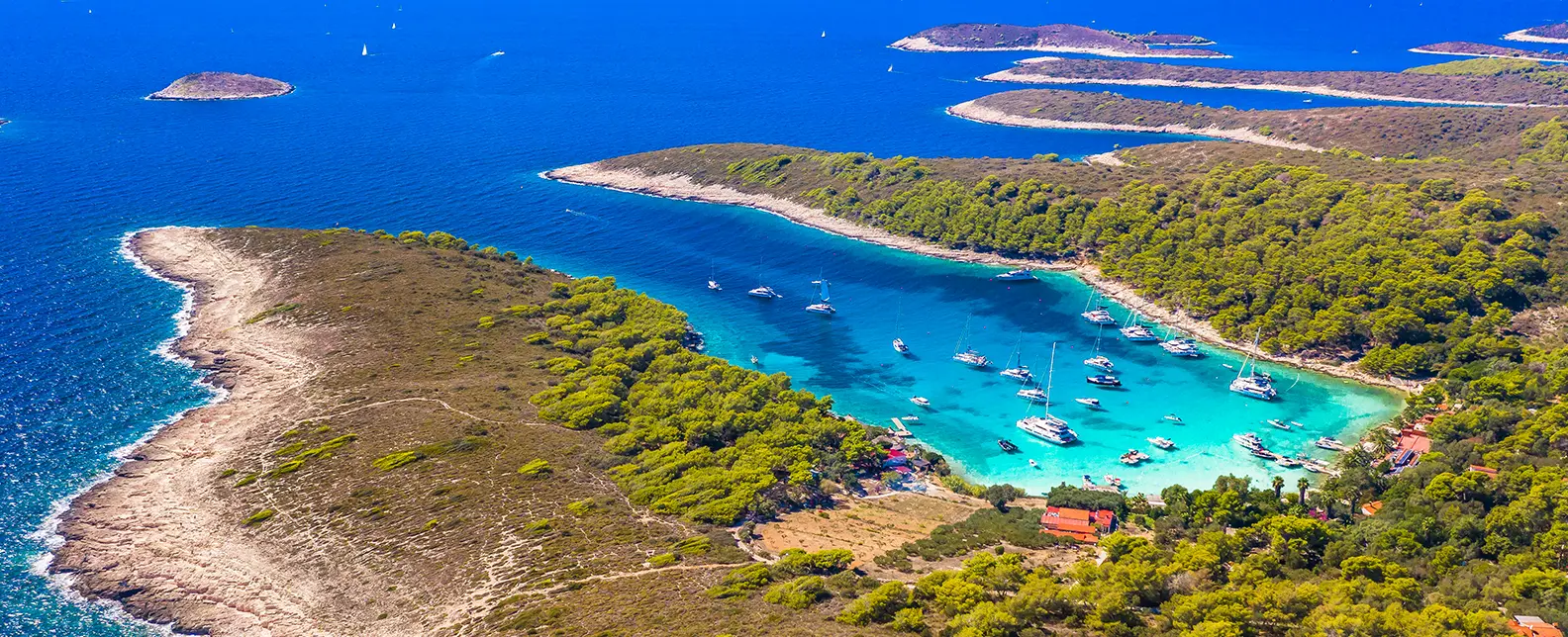
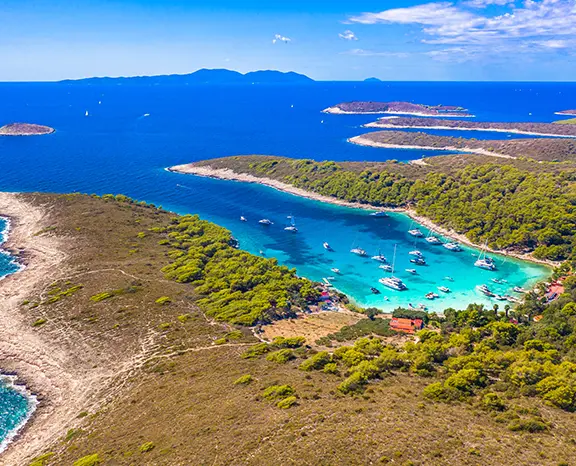
Count on a fifteen-mile leg southeast from Milna over the Hvar Channel to the Pakleni, the long line of pine-covered islets screening the southern approach to Hvar Town. Palmižana is on the east side of Sv. Klement, the biggest of them, and its ACI marina, the only one in the group, offers stern-to lazy-line berths with little room in summer. In the open bay the anchor holds in 5 to 10 metres of sand and weed, but around mid-afternoon the Maestral funnels in and the boat starts to roll. The south-side coves, Vinogradišće and Tarsce, are more restful overnight, with a line ashore and good holding in a westerly. The swimming here is the best part. Off the western shore you can snorkel above Roman amphorae lying on the bottom. On land there is the Meneghello family's botanical garden from 1906, four konobas round the bay, and a path across the islet to Vlaka Bay. Hvar Town is a short water-taxi ride east, but the Palmižana side is always the calmer night.

Things to do

Swim out to the amphorae off the west shore

Spend an hour in the Meneghello botanical garden

Tie a line ashore in Vinogradišće

Hop over to Hvar Town on the water taxi

Hike the island path to Vlaka Bay

Mooring tip

Book ACI Marina Palmižana online for July and August. If it is full, Vinogradišće on the south side offers sand and weed with a line ashore and better cover in an afternoon westerly. Avoid spending the night in the main bay when a southwesterly is building.

Komiža
4
Day 4

Palmižana → Komiža (Vis)

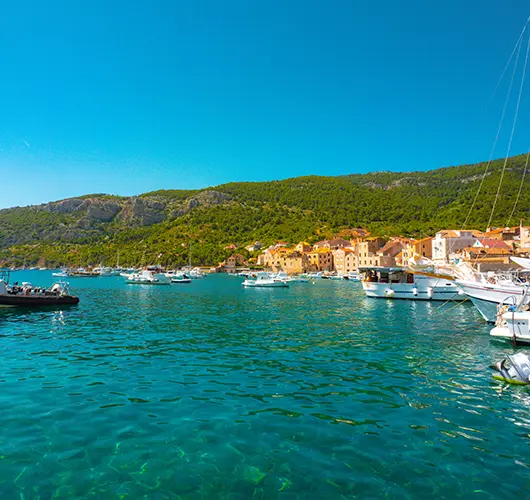
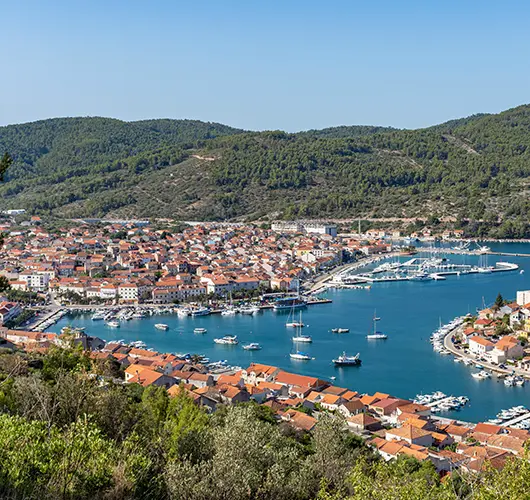
Out beyond the Pakleni the sea opens up, and twenty miles southwest brings you to Komiža on the western coast of Vis. Vis is the most westerly inhabited island in Croatia. It was a closed military zone until 1989, and there is still little resort building, so its small towns feel like the Adriatic of decades ago. Komiža can be walked end to end in fifteen minutes. Fishing boats moor along the harbour's eastern side, and an old Venetian tower houses the Fishermen's Museum, open in the afternoons, and the konobas serve grilled bogueroni with Vugava, the island's own white. For a longer walk, climb Mount Hum. Tito's Partisans and the British SOE coordinated WWII operations from Vis, Tito's Cave on the mountain is open to visit, and the summit gives a view right round central Dalmatia. Back in the harbour, moor in the inner basin, stern-to on your own anchor; the outer wall is open to southwest swell.

Things to do

Wander past the fishing boats in the evening light

Try bogueroni and a glass of Vugava

Walk up Mount Hum to Tito's Cave

Spend an afternoon in the Fishermen's Museum

See the sun go down from the harbour wall

Mooring tip

Berth stern-to on your own anchor in the inner basin; sand and weed give mostly good holding, and there is a harbour fee. The outer wall is not safe overnight in southwest swell. If a southwesterly above 15 kn is forecast, go 6 NM north to Vis Town in St. George Bay, which is well sheltered.

Vela Luka
5
Day 5

Komiža → Blue Cave (Biševo) → Green Cave (Ravnik) → Vela Luka (Korčula)

Breakfast early, because the Blue Cave on Biševo glows only while the sun reaches through its underwater entrance, roughly from 09:00 to 11:00. Then the inside turns a deep ultramarine. Tie up alongside the small concession quay outside, pay the lunchtime fee at the kiosk and wait for an official boat; private dinghies may not enter, and you cannot stay overnight. In and out takes about forty minutes. A short hop east lies Ravnik and its Green Cave (Zelena špilja). Light falls through an opening in the roof instead of under the water, you are free to go in by dinghy, and it is calmer and less crowded than Biševo. After lunch, sail 18 miles east to Vela Luka, the deep harbour opening to the west at the end of Korčula, sheltered from north to east and with full town services. Dinner is žrnovski makaruni, the island's pasta, still rolled by hand in a couple of village kitchens.

Things to do

Wait for the official boat into the Blue Cave

Row your own dinghy into the Green Cave

Watch the south side of Vis slide past

Eat hand-rolled makaruni in Vela Luka

Take an evening walk along the waterfront

Mooring tip

Moor stern-to on your own anchor at the long town quay for a modest fee, with water, power and a fuel pump at the western end. The mud and sand bottom holds very well. The harbour is closed to north, northeast and east, and only a southerly above 18 kn pushes swell inside.

Zaklopatica
6
Day 6

Vela Luka → Lastovo (Zaklopatica)

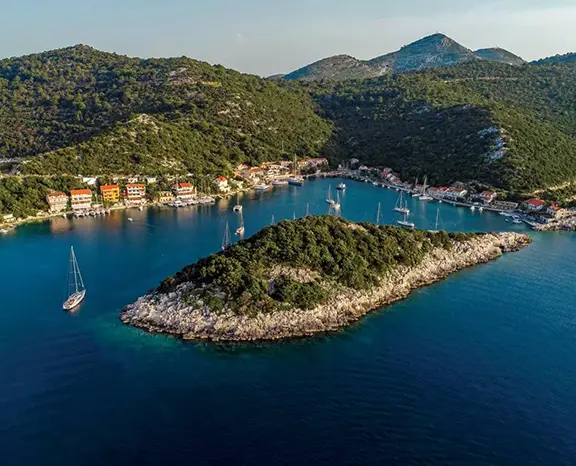
Lastovo is nineteen miles south, a Nature Park with the lowest light pollution in Croatia and the quietest island of the central Adriatic in summer. Most crews spend the night in Zaklopatica, a U-shaped bay on the north coast where a low islet across the mouth keeps the swell out. Five family konobas each keep a row of free buoys for diners, so the arrangement is simple: book your buoy and your table at the same konoba. Anchoring is discouraged because of the seagrass meadow, but outside the July peak there are usually enough buoys. Spend the afternoon in the water around the islet, or walk the path inland to Lastovo Town and its fumari, the old chimney stacks. In the evening, try the lobster (jastog) or šporki makaruli, a rustic beef and pasta stew. There is little else to do, and that is exactly the appeal. On a clear August night the Milky Way crosses directly overhead before midnight, bright enough to read by in the cockpit.

Things to do

Moor on a konoba buoy in return for dinner

Try jastog or a bowl of šporki makaruli

Follow the inland path to the fumari

Snorkel right round the entrance islet

Stay out in the cockpit after midnight

Mooring tip

Free konoba buoys are held by a dinner booking; agree yours on arrival, and do not anchor on the seagrass. The bay is sheltered from north to west. If a southeasterly above 15 kn is on the way, go 4 NM south through the channel to Skrivena Luka, also known as Portorus.

Mljet
7
Day 7

Lastovo → Mljet (Polače)

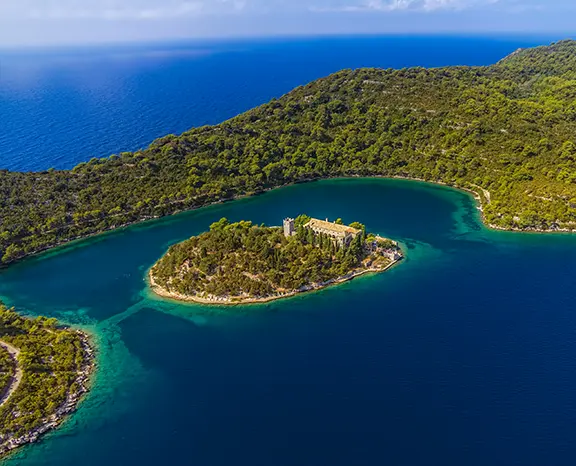
Give today to Mljet's lakes. The sail is 22 miles northeast from Lastovo, and in the second half Polače opens on the north coast: a long inlet whose entrance stays hidden until you are inside, then widens into one of the most sheltered overnight bays in southern Croatia. This is the western entrance to Mljet National Park, and the Park manages the bay. Take a green buoy and pay at the ranger kiosk on the front, which covers Park entry for everyone aboard, or ask for a stern-to place at the small village pontoon. A few metres from the water stand the walls of a 4th-century Roman complex, basilica and corner tower, free to walk through. From there a thirty-minute walk leads to Veliko Jezero, the larger of Mljet's two saltwater lakes. A small Park boat goes out to St. Mary's islet and its 12th-century Benedictine monastery. The trail round both lakes is about 9 km, swimming is allowed, and apart from the cicadas it is quiet.

Things to do

Pay the ranger for a buoy as you arrive

Walk through the Roman walls on the waterfront

Ride the Park boat to the monastery islet

Loop both lakes on the 9 km trail

Swim in the lakes, cooler than the sea

Mooring tip

Paid Park buoys here include crew entry to the Park; pay the ranger when you arrive. The bay is one of the most sheltered on the southern coast, closed to north, northeast, east and southeast. A few boats can also lie stern-to on their own anchor at the village pontoon.

dubrovnik
8
Day 8

Mljet → Dubrovnik

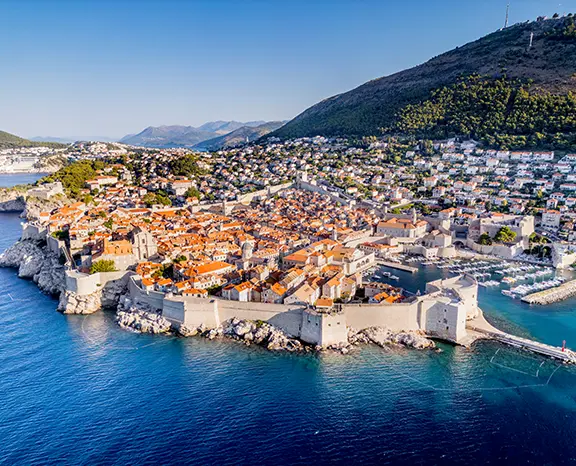
Thirty-four miles southeast takes you to Dubrovnik, or more exactly to the marina eight kilometres inland. Charter yachts spend the night at ACI Marina Dubrovnik in Komolac, up the long, fjord-like estuary of the Rijeka Dubrovačka, where every berth has lazy lines, water and power and there is a fuel pontoon, restaurants and a chandler. The Old Port by the city is a small, lovely UNESCO setting, but it is for visitors by day only, open to the south and crowded with tour-boat tenders all summer. From the marina, Bus 1A or a taxi reaches Pile Gate in about fifteen minutes. This is a walking evening. Start at Pile, climb onto the walls and go all the way round, about an hour and a half with a few pauses, then come down into the Stradun and find dinner in the lanes off Prijeko. If you prefer, take the cable car up Mt. Srđ from the eastern side of the Old City instead; the view back over the roofs at dusk is the classic picture.

Things to do

Walk the whole wall circuit before sunset

Ride the cable car up Mt. Srđ

Eat in a side street off Prijeko

See the Rector's Palace and Franciscan cloister

Sip a drink at Buža on the rocks

Mooring tip

ACI Marina Dubrovnik in Komolac is the only practical place to spend the night; book ahead in season. The Old Port is a daytime tender stop and never an overnight. Allow half an hour from the marina pontoon to Pile Gate by Bus 1A or taxi.

Okuklje
9
Day 9

Dubrovnik → Okuklje (Mljet)

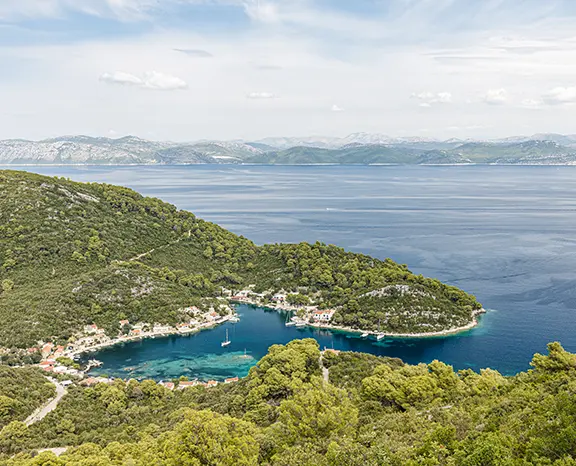
After the city, a slow day. The return starts with 20 miles northwest to Okuklje on Mljet, a tight U-shaped bay that holds perhaps twenty boats. There is no town and there are no day-trippers. Okuklje lies outside the National Park, so there are no Park fees either, just three family konobas that lay free buoys for their dinner guests. Pick up a buoy, row ashore and reserve a table to keep it. The bay is a long crescent, with hills about a hundred metres high on three sides, so the wind falls away at sunset whatever it does outside; at night the only sound is the sea at the entrance. Have a swim before lunch, then take the path round the headland for the view over the Pelješac Channel and Korčula. For dinner, black risotto (crni rižot) made with cuttlefish ink and the catch of the day, or grilled bream.

Things to do

Keep your buoy by reserving a table

Taste crni rižot coloured with cuttlefish ink

Hike round the headland towards Korčula

Dive in from the boat on calm water

Rest in the quietest bay of the route

Mooring tip

Buoys are free when you eat at the konoba; confirm on arrival. Anchoring on the bottom works, but holding in the seagrass is patchy. The bay is sheltered from north, east and south; only a northwesterly above 18 kn sends noticeable swell into the entrance.

Korčula
10
Day 10

Okuklje → Korčula Town

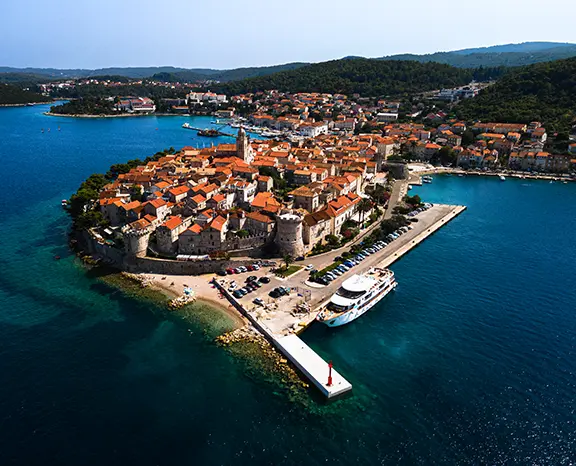
Korčula Town appears early, a peninsula of red roofs with one bell tower and limestone walls running into the sea on three sides. The sail is twenty-nine miles northwest up the Pelješac Channel to this walled medieval port at the eastern end of the island. For berths there are two options. ACI Marina Korčula, on the eastern side of the peninsula, has lazy lines and full services. On the western side the town quay takes a handful of boats stern-to on their own anchor for a fee; it is closer to the gates but open to the west, and it rolls when the channel wind arrives in mid-afternoon. On foot the Old Town is very compact, ten minutes from one end to the other, and its street plan is the well-known fishbone: one main street with short lanes on each side. Climb the bell tower of the Cathedral of St. Mark for the channel view. Then see the Marco Polo House, whose claim is debated, and the Land Gate with its surviving Venetian relief.

Things to do

Walk the walled lanes in the cool of evening

Climb the tower of St. Mark's Cathedral

Look in at the debated Marco Polo House

Order fish brodet in a courtyard konoba

Watch the Moreška sword dance in season

Mooring tip

Choose ACI Marina Korčula on the east side in any wind; it has lazy lines, water and power. The west-side town quay takes boats stern-to on their own anchor but is open to the Maestral and rolly on summer afternoons. If the channel gets rough, shelter in Lumbarda Bay, 3 NM southeast.

Jelsa
11
Day 11

Korčula → Jelsa (Hvar)

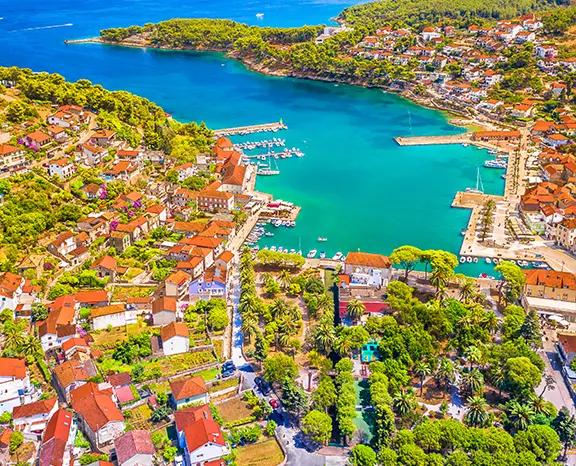
From Korčula, sail about forty-two miles round the eastern tip of Hvar and west along the Hvar Channel to Jelsa on Hvar's central north coast. It is the island's third town, about half the size of Hvar Town on the south side and much quieter. The wide bay is well protected from the south. On the town quay you lie stern-to on your own anchor for a harbour fee, with good holding in mud and sand, while a small marina on the eastern side offers lazy lines and shore power. This is the start of Hvar's farming interior. Lavender lines the road to Vrboska and Stari Grad and is still harvested commercially each July, and in the back streets the konobas serve the local Bogdanjuša white and Faros cheese, named in Greek. There are two good ways to spend the afternoon. You can cycle three miles along the coast road to Vrboska, the little Venice of Hvar with its canal and bridges. Or you can walk inland through the Stari Grad Plain, a UNESCO site and one of the oldest continuously farmed landscapes in Europe.

Things to do

Pedal along the coast to Vrboska

Walk the old field paths of the plain

Taste Bogdanjuša in a back-street konoba

Look for lavender oil in season

Go up to the Tor watchtower for the view

Mooring tip

Berth stern-to on your own anchor at the town quay for a small fee, with water and power in the central section. The bay is sheltered from the south, southeast and southwest and open to the north, which in summer usually means only a late-season Bora; the small eastern marina has lazy lines as a fallback.

lucice
12
Day 12

Jelsa → Lučice Bay (Brač)

Today is mostly about the water. It is only a short crossing north-west to Lučice, a row of small coves on Brač near Milna. Nobody lives on the headland; it is all white limestone cliff and pine forest. The only buildings are two seasonal beach restaurants that lay free buoys for guests who eat there. Pick up one in the deepest of the three coves, jump in and let the day go by. The white limestone of Brač gives the seabed its pale colour, and on a calm summer day you can see about 20 metres down. When you get hungry, the two restaurants keep things simple, with grilled fish and the local Plavac Mali red. There are no shops and no nightlife, which is the whole point of coming here. If every buoy is taken, anchor on sand and weed in 8 to 12 metres.

Things to do

Moor on a free buoy in the middle cove

Swim with a mask above the pale seabed

Come ashore for grilled fish and red wine

Explore the other coves by dinghy

Paddleboard around the headland at sunrise

Mooring tip

Restaurant buoys are free with dinner ashore; ask when you arrive. Otherwise anchor in 8 to 12 metres on sand and weed. If strong wind is forecast, head for the protected harbour of Milna nearby.

krknjasi
13
Day 13

Lučice → Krknjaši Bay

This is the swim of the fortnight. Krknjaši Bay is fifteen miles northwest of Lučice, in the channel between Veli Drvenik and Mali Drvenik, two small islands west of the Trogir base. The bay is shallow, with pale sand 3 to 6 metres down and water that turns turquoise on a calm day, and the anchor holds very well. Three restaurants on Veli Drvenik, which has no road access and is reached only by boat, lay free buoys for diners, but on a floor this shallow and sandy most crews simply anchor. On the eastern side of the bay there is a tiny chapel, and a footpath goes round the headland in about thirty minutes; there is nothing else ashore. Stopping here on day 13 is also practical. The return to ACI Trogir on Saturday is short, so the morning will be unhurried, and you will come back with the right amount of fuel and no stress.

Things to do

Anchor on sand and swim straight off the boat

Circle the headland on the half-hour path

Eat grilled fish at a beach restaurant ashore

Taste the local Plavac and rakija

Watch the sun set over the open sea

Mooring tip

Anchor in 4 to 6 metres on sand with excellent holding; the shallow bay is forgiving. Restaurant buoys are free with dinner. Shelter is good from north, northeast, east, south and southeast, but the bay is open to the west and northwest; above 18 kn from the west, go east directly to ACI Marina Trogir.

Trogir
14
Day 14

Krknjaši Bay → Trogir

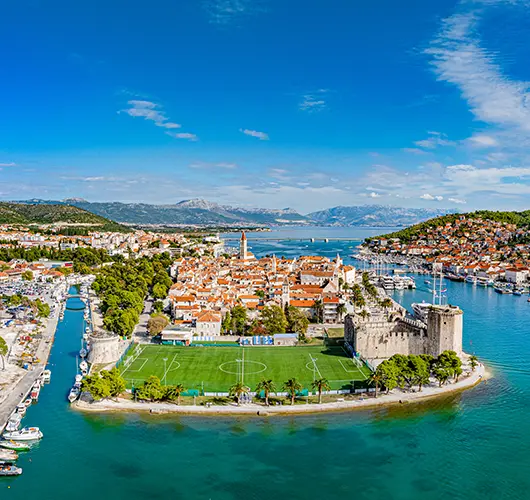
Only a short run separates Krknjaši from ACI Marina Trogir, the shortest leg of the round trip, so there is time for one more swim before you go. The usual Saturday handover follows: the boat must be back by 09:00 with fuel topped up, holding tanks emptied, decks rinsed and inventory checked, and the skipper should be aboard for the inspection between 08:00 and 09:00. The marina sits on the western side of Čiovo, facing the UNESCO old town of Trogir. Once the boat is signed off, it is a five-minute walk over the small bridge into town. The Cathedral of St. Lawrence and its 13th-century Radovan portal, one of the great works of medieval Croatian sculpture, is the main sight, and the Riva runs along the marina side. Split airport is ten minutes north by car. Close the trip with a long lunch on the Riva or a last slow walk through the old streets.

Things to do

Fuel up and pump out before the check

See the Radovan portal of the cathedral

Look round the Kamerlengo fortress

Swim at the little beach on south Čiovo

Have a long lunch on the Trogir Riva

Mooring tip

Return to ACI Marina Trogir as your contract states, and the base manager will direct you to a berth. Handover is 08:00 to 09:00 on Saturday; if your contract specifies night-before return, be in by Friday afternoon. The fuel pontoon is by the western entrance of the marina.

— Plan your week

Book this week and we'll find the boat for it.

Tell us your dates, how many of you are sailing and the kind of boat you like. A charter agent sends a quote for this route within hours.